The end is on the way
To answer the question I am often asked: “no, the blog hasn’t been fogotten, it’s just been neglected.” I have made myself a promise to finish our tales, so stay tuned (or not)….updates will appear below this date.
Jun 11
To answer the question I am often asked: “no, the blog hasn’t been fogotten, it’s just been neglected.” I have made myself a promise to finish our tales, so stay tuned (or not)….updates will appear below this date.
Oct 14

The stifling heat and humidity slaps us hard in the face when we arrive in Hanoi and it’s only 6am in the morning. The taxi drops us at the Hanoi Chic Hotel, located in Hanoi’s old quarter.
We have a large room with a balcony overlooking the street below, best of all its air-conditioned. We run that air-conditioner non-stop for our entire stay!
Immediately we note a difference in the atmosphere between China and Vietnam. There is a more upbeat vibe to the place and the Vietnamese are just a bit more warm and welcoming.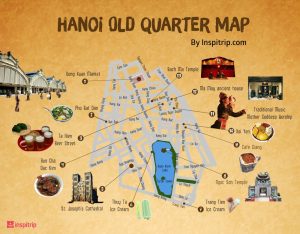
To avoid the heat, it’s best to venture out for short trips during the day, coming back to cool down with a shower and change your dripping clothes. Late afternoon and evenings are cooler and much more pleasant times to go exploring.
The street scape is chaotic, people, bicycles, motorbikes, and cars navigate through meandering lanes and alleyways. Shops overflowing with their stock spilling onto the street.
You can find just about anything you can think of; bamboo scaffolding, lanterns, shoes, and handbags next door to plumbing supplies
Many of the streets are named after the product or merchandise it sells; Hang Bac for silver, Hang Be for bamboo, Hang Dao for silk and so on.
Hanoi is layered in centuries of history and has been under Chinese, French and Japanese rule. We spend our time discovering the various districts the city is divided into. The Old Quarter with its cobbled streets has been the trade hub for over a 1000-years.
We love Vietnamese food, and you can eat your way through the day here. The colonial French influence is evident in the architecture as well as the croissants and mouth-watering array of pastries.
One of the highlights was the Hanoi Street Food Tour. Perched on the back of Scooters we weave our way through the traffic, our guides providing local insights and a history lesson along the way.
We stop a number of times to sample a variety of delicious dishes. The street stalls are bustling places, and we join the locals, perching on plastic stools often sprawling onto the street.
Coffee production was brought to Vietnam by the French, and they are now the world’s second-largest coffee producer after Brazil.
During the Indochina War (1946), there was a milk shortage, a local bartender created Egg Coffee and it is still popular today. It’s decidedly sweet and creamy, made on eggs and sweetened condensed milk and butter.
A focal point for the city is the Hoan Kiem Lake, at its centre is the Turtle Tower, built over 150 years ago as a resting place when the King went fishing. During the French occupation it became a symbol of patriotism when the Vietnam flag was hung on it by revolutionaries.
At the west end of the lake is St Joseph’s Cathedral, Hanoi’s Notre Dame. Built in 1886 it is one of the largest churches in Hanoi.
We organise the next leg of our trip with local travel agents, we are off on a 3 day/2 night boat trip to Ha Long Bay, followed by a trip south to Mai Chai and Ninh Binh, we were hoping to visit the rice terraces of Sapa in the north but it’s the wrong time of year.
Sep 21

Nimen Hao!
The next leg of our journey is a 15 day Intrepid Tour from Beijing to Kashgar, following the Silk Road; one of the world’s most ancient trade routes.
We are the only two to make the meet-and-greet with Peter, our tour leader.
This will be our 4th (my 5th) Intrepid Tour so, we are pretty familiar with the intro programme.
It’s going to be an intimate group of 5 Australians; Pia and Andrew are arriving later tonight and James, who will be meeting us in Xian.
The trip begins with a 12-hour overnight sleeper train. Train travel in China may not be entirely luxurious, but it’s certainly one of the best ways to come face to face with the country and its people.
Compartments are open-plan, clean (well that’s what the brochure said), with padded three-tiered berths (6 to a compartment). Sheets, pillows and a blanket are provided.
Peter assures us that the sheets are clean because the train starts here. I don’t want to think about what that means when you board a train mid journey…
I can probably ignore the sheets, I’ll be sleeping fully clothed, but I am glad we purchased pillowcases.
The term ‘Sleeper’ carriage proves somewhat debatable. As we slowly roll out of Beijing our carriage is full and animated with chatter, card games and music – that continues throughout the night.
I’m not taking any chances ensuring a good night’s sleep and pop a Valium (staple travel drug), which assures me of a few hours’ reasonable shuteye.
Onboard there is boiling water, in the morning Don pulls out the plunger and we start the day with coffee, we also had the foresight to bring milk with us from Beijing.
Basic bathroom facilities are situated at the end of each carriage, by basic I mean squat toilets that open onto the tracks. If this was an ensuite situation I probably wouldn’t be too fazed. It’s the 59 other people I’m sharing with (aside from my husband), who may not have the same hygiene standards, which disturbs me!
I figure I’ve got three options:
1) limit fluid intake before and during the trip to avoid using the toilets at all,
2) use toilets early in the trip (whilst they remain in reasonable condition) or,
3) take lots of disinfectant wipes, hold my breath, roll my pants up and close my eyes!
On this particular trip, I opt for option 1 (which remains my preferred strategy). Throughout the tour, we take 5 overnight train trips and I put all three strategies to the test; my advice is to avoid option three wheresoever possible!


Xi’an
Early morning we arrive in Xi’an, the imperial centre of China for over 2,000 years and the oldest of the four great ancient capitals.
Today Xi’an is a vibrant modern city with a population of 9 million. Considered a mid-sized city by China’s standards.
Xi’an marks the beginning of the Silk Road. However, it is probably better known as home to the Warriors of the Emperor Qin Shi Huang, who were immortalised in terracotta.
After dropping our luggage at the hotel, we have a western style breakfast of eggs, toast and coffee (the last we see for a while), before embarking on a 2-hour commute to visit the terracotta warriors.
Discovered in 1976, it is a remarkable piece of history; over 8,000 soldiers, horses and chariots stand in battle formation protecting the emperor in his afterlife.
Every figurine has unique facial features, its own expression and hairdo. It is spectacular and one of the highlights of our time in China.
I’ll defer to the experts and recommend anyone interested to pursue further reading from more qualified sources, such as the National Geographic: Emperor Quin’s Terra Cotta Army
Dinner that night is a banquet of dumplings and Tsingtao (local beer). Xi’an is a city we could certainly have spent more time exploring.
Tianshui

The ‘Lounge’
Day three is a leisurely daytime train trip to Tianshui, the 4-hour journey is a relatively short commute in the scheme of things.
Peter, our tour leader is a little overzealous about being at the train station well ahead of departure – I’m talking 2 plus hours! And it’s not like there is a ‘club lounge’ to hang out in.
Over the coming days we convince him to relax a little on departure times. It’s much easier and quicker herding 5 people than the usual group size of 16.
Tianshui is situated on the Wei River, renowned for its culture and history dating back over 2000 years.
Buddhism was introduced in China back in the mid-5th century and about 45 km from the city, the surrounding Majishan Mountain are the site of a major Buddhist temple.
The mountains rise up abruptly 142 meters from the landscape. The people named the mountain ‘Maiji’ because it resembles a stack of wheat straw (mai meaning wheat, and ji meaning stack).
The sheer cliff faces hold over 194 Buddhist caves and niches, contain more than 7,200 clay statues and over 1,300 square meters of murals. Works of art from ancient craftsmanship, dedication to the Buddhist ideal.
Tianshui for me marks the beginning of most of our meal being heavily seasoned chilli. I don’t love chilli!
With a population of 3.5 million, this is a relatively small city. After visiting the caves, we have plenty of spare time, unfortunately, there isn’t much else to see or do with that spare time!
As a westerner, particularly a blond(ish) one, we often found ourselves the centre of attention.
Without warning you’d find someone siding up to you and thrusting a selfie stick out in front to snap a pic! The more polite Chinese ask as they took the photo, most just sneak-on-up, take it, giggled,and run away.
On the main street of Tianshui there is a bar with outside pool tables. We decide to have a game and before long there is a crowd of locals watching us.
By 11pm, it’s all aboard for another sleeper train to Zhangye. I’m in the lower bunk and a young mum with an 8-month-old baby is in the bunk opposite me.
I learn that nappies are a luxury and not considered a necessity in China. In the early hours of the morning, I also learn why baby pants come with a split up the middle and how they learn to squat from an early age.
Squatting anywhere you please seems to be acceptable, even on the floor of the train carriage!
Zhangye
The train arrives into Zhangye in the early hours and check into our ‘Guesthouse’.
I am not sure why they insist on calling the accommodation ‘Guesthouses’, they are grotty and derelict hotels. The foyer might look reasonable but, that’s just to lull you into a false sense of comfort.
We’ve been given the ‘honeymoon’ suit, with mood lighting and a round bed! I’m not sure it qualifies as a bed because the mattress is so hard, we could play table-tennis on it.
Today’s adventure is a visit to Zhangye Danxia Landform Geological Park.
Of course, it’s another UNESCO World Heritage site – one day I’m going to count up how many world heritage sites we’ve managed to visit!
The landscape is a striking contrast to its surrounds; a tumultuous layer cake with folded waves of reds and yellows sharply contrasting against the greens and greys of the plains.
The land formation is the result of sandstone and mineral deposits being layered over 24 million years.
There are viewing platforms dotted around various locations within the national park. We are shuttled around on buses from one spot to another. The whole exercise taking several hours.
The town of Zhangye does not offer much, dinner is mediocre – more dishes laden with chilli – this is certainly good for some much-needed weight loss.
We had such a bad night’s sleep on our rock-hard round bed, that I’m actually looking forward to the train bunk bed for the overnight journey to Turpan.
Turpan
Once an important staging post on the Silk Road, Turpan is an attractive oasis town famous for its vineyards, stone fruits, melons and the nearby Flaming Mountains.
The country roads on the outskirts are lined with poplars and lovely old mud brick dwellings of the Uyghur people, while the modern ‘inner’ town has shiny new buildings, spacious streets and public squares.
We visit the ruined city of Jiaohe, the Bezeklik Buddhist caves and the ancient Karez underground irrigation system, which still provides water for the agricultural needs of the area.
We also visit the old Uyghur village of Tuyoq where the grape trellises draped around the city provide welcome shade in the summer months – temperatures can easily reach 45°C here!
We check out the Emin Mosque with its monumental minaret, the tallest in China and the Astana Cemetery which dates back to the 4th century.
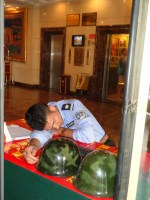
Security
The standard of hotels has consistently declined as we’ve travelled further west.
In Turpan we have no hot water, air-con that doesn’t work and disinterested staff who just don’t care.
It’s certainly been an interesting experience, but I’m glad the end is in reach. Our final train journey is a short, 2-hour ride to Kashgar.
Kashgar
Kashgar is very much a frontier town, from here roads lead into Pakistan, Tajikistan, Kyrgyzstan and beyond.
There are few signs that you are still in China – other than this is home to the country’s largest Chairman Mao statue.
This once ancient city is quickly modernising. In 2011, the Chinese government started rapid demolishing of the Old Town of Kashgar.
The official word it that it was due to the old city being overcrowded, with poor drainage and vulnerable to earthquakes.
The unofficial story: this was as an excuse to tighten security measures and limit religious practices of the Uyghurs, who are mostly Sunni Muslim. The Uighur families were relocated to newly built apartment blocks.
The town’s main landmark is the Id Kah Mosque and its surrounding square, from which dusty old lanes lead off, crammed full of shops, food stalls and Uyghur locals living a lifestyle virtually unchanged for a hundred years.
Kashgar has been an epicentre for trade for more than two millennia. The main attraction is the Sunday Bazaar. The modernised version of this centuries old market is divided into two sections – the Downtown Bazaar, which sells clothing, household goods, produce and everything else you could imagine, and the Animal Bazaar just outside the city.
The Animal Bazaar is hustle and bustle, where the local herdsmen and farmers are trading and bartering for sheep, goats and cows. It’s not for the vegetarians or faint hearted with freshly butchered animals on display.
And here ends our journey through China. The tour has been interesting and certainly an eye opening experience. It was not the picturesque journey down cobbled streets and ancient chinese architecture that I expected. Nonetheless is was a great experience and insight into Chinese culture and the rapid development going on in this part of the world.
Sep 15

We land in Beijing very early in the morning. Our pre-booked driver is nowhere to be seen. After a few phone calls and a 30 minute wait, he finally arrives somewhat apologetic.
The sun is starting to rise as we begin our journey into the centre of Beijing.
It looks like a clear day and there is no evidence of the polluted haze this city has a reputation for. The traffic is light, but given the early hour, it isn’t surprising.
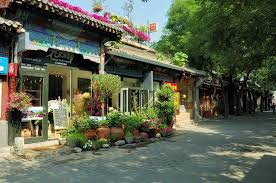
By 7:00am we are at the Peking Youth Hostel. Our room won’t be ready for a few hours, so we store our luggage and go for a wander through the quiet streets.
The hostel is located in the middle of one of Beijing’s most colorful Hutong districts, in a charming quaint lane, only a few blocks north of the Forbidden City.
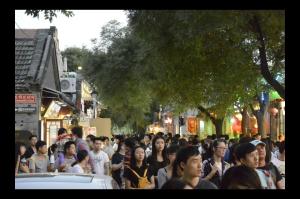
Hutongs are a collection of narrow streets and alleys, commonly associated with northern Chinese cities, most prominently found in Beijing. At this time of the morning it’s a peaceful oasis in a hectic city. Little do we know how different the scene would look in a few hours.
Tired and jet lagged, we nap on couches in the guest lounge until our room is ready.
Our first taste of china is from a street stall selling freshly made dumplings. They’re so good, we go back for seconds!
Beijing was once considered the ‘kingdom of bicycles’, with over 9 million people commuting on two wheels. With the rise of the middle class, the two wheels are quickly being replaced by a more prestigious fuel-injected four.
Opting for two wheels, we join the organised chaos on the streets. Wide bike lanes accommodate everything from scooters, wheel barrows and tuk-tuks.
It’s a game of concentration; weaving in and out of other riders, avoiding parked cars and other hazards. However, it all seems to work and with a good map it’s surprisingly easy to navigate our way around.
We rented our Bikes from the very friendly and helpful team at Bike Beijing. They also gave us some great tips on local places to eat. And we were not disappointing with their Peking Duck recommendation – Siji Minfu.
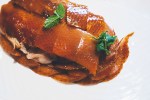
A popular restaurant with locals, expats and tourists, there are no bookings; you just turn-up and get in the queue. We plonk ourselves on little stools out the front to wait our turn. The meal was worth the hour wait; the crispy Peking Duck expertly carved at our table is mouth-watering delicious!
The Hostel staff provided us with lots of recommendations and advice as well (bit of a theme going on) and helped us organise a two night stay near Mutianyu – one of the more scenic Great Wall locations.
It’s a 2 hour bus ride from Beijing, followed by a 1 hour taxi ride. We have a long-winded negotiation with a woman who approaches us in her not-so-official taxi, eventually agreeing on US$20 to drive us to our destination.
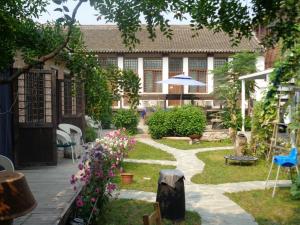
He Yi Little Yard is a quaint Bed & Breakfast nestled between mountains in the village of Sanduhe, 8 km from Mutianyu.
The rooms are decorated with natural materials and cultural artifacts. The courtyard is a peaceful oasis; filled with bamboo, date trees, vegetable plants, and a stream swimming with goldfish.
Meals are included and are made with ingredients grown or purchased from local farmers. The food was wholesome and delicious.
Borrowing bikes (a tad too small), we embark on the 16km loop which takes us through local villages, rice paddies and across streams.
We stop mid-way in Mutianyu, where there is a cable car that takes you up to the wall.
This ancient wonder is an impressive feat in engineering, snaking haphazardly over rugged mountains and desert, constructed over centuries. Oficially, it covers over 21,000 kilometers.
Indirectly, construction of the wall began around 500 BC; with independent kingdoms building their own defences.
During the Qin dynasty hundreds of thousands of men, mainly political prisoners, provided the labour for an estimated 10 years to link walls with unifying kingdoms.
In the Ming dynasty, engineers took on a century-long project to revamp the wall. Ultimately it failed when Mongol armies arrived in 1279.
In later centuries, the invention of the aeroplane would also render the wall somewhat pointless. Without the tourist industry, the wall would probably have been left to crumble away.


The Forbidden City is the largest palace complex in the world. This former palace was shrouded in mystery for over 5 centuries until the Republic overthrew the last emperor in 1912.
If you plan a visit, it can take a good part of the day to wander through the ancient buildings, courtyards and gardens. The self-guided audio is worthwhile, it provides plenty insights and allows you to set your own pace.
Our tips; there is a daily limit on the number of people allowed to enter, so arrive early and get ahead of the queues. Don’t forget your passport, as ticket purchases are subject to the ‘real-name’ policy.
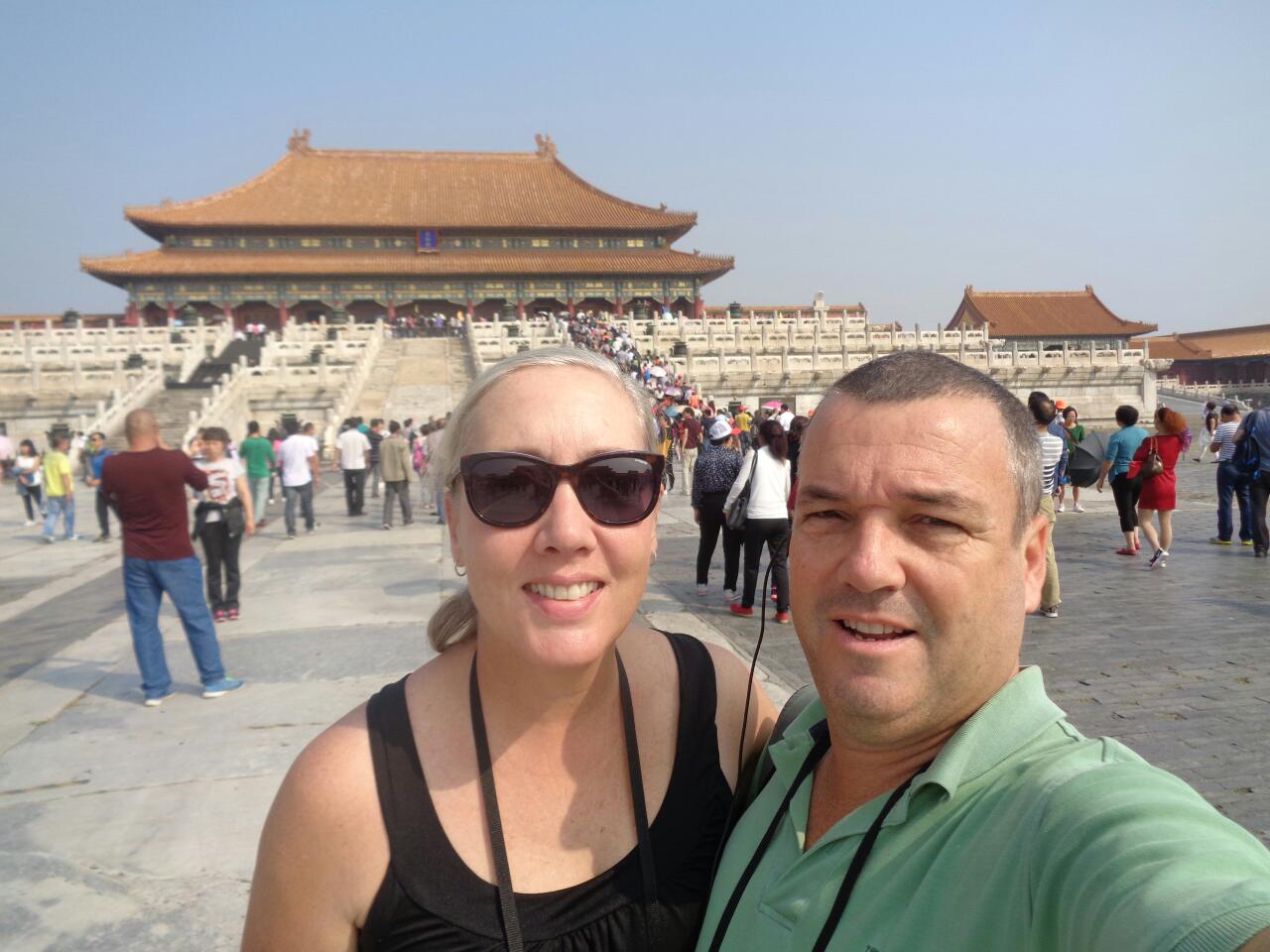
Forbidden City
Tiananmen Square is apparently the largest downtown square in the world. Framed by the Gate of Heavenly Peace with its Mao portrait, the square is heavily controlled by a strong police presence. Our visit was a brief stop whilst cycling past.
In the northwest quarter of Beijing is the area known as Shichahai. Locally refered to as the Hòuhǎi Lakes, it’s a popular recreational spot during the day, transforming into a lively nightspot with rooftop bars and restaurant. The surrounding neighbourhood also consists of an extensive Hutong network.
Continuing on with historical sites, we visited The Lama Temple. Built in 1694, it is the largest and best-preserved Tibetan style monastery in Beijing.
Bargaining is an art form in China, one that Don relishes in! We visited a few markets where we purchased designer brands ridiculously cheap; $20 for a North Face jacket, $30 for Merrill shoes (should have bargained harder). Don also picked up a pair of traditional slip-ons from a street peddler for $11 (surprisingly these didn’t last all that long, as they fell apart soon after)!
Were these items the real deal? We’re not naive enough to believe they are genuine, but at those prices, who cares!
As the capital of the most populous country on earth, Beijing surprised us both. Its emerging contemporary culture seems obsessed with western style luxuries and modernity, yet amongst the soaring skyscrapers and modern shopping malls, this city still possesses an ancient charm and beauty.
Sep 11

So this is our situation: We need to cover 1,200km to reach Zürich, and six days to do it in. There are also four people we’d like to catch-up with en route.
The first night we stop in the small town of Nieburg, Germany. There is nothing outstanding to write home about, it was simply a suitable way-point to end our first day of travel southwards.
Dinner reminds us that we are back in Germany; the land of beer, schnitzel and sauerkraut. I make the mistake of ordering a salad, only to end up with an extra serve of cabbage!
Next stop is Dortmund. This town probably wouldn’t feature much in tourist guides, however the attraction for us was to catch-up with Inga, who we met on our Mexican adventures.
Inga has grown up in the area and also spent some time in Australia with her studies. She works in wind-turbine energy, which is huge in this part of Europe. She kindly offered us a bed, generously taking the couch and vacating her own comfy bed for us. It was a quick visit, as Inga was off early the next day, to holiday in Kenya.
We head out to dinner and see a snippet of Dortmund. As brief as it was, it was lovely to see Inga and get a locals perspective into what living in Germany is like. Inga, we hope you come and visit soon, so we can repay the hospitality.
Following the Rhine, our next stop is the town of Boppard. I wouldn’t rate the river as scenic as the Danube had been, though it could make a nice cycle trip one day.
Driving on a German autobahn is not for the faint-hearted. Impatient drivers weaving in and out of lanes at high-speed (there are no limits enforced), is a recipe for catastrophic accidents.
If you dare sit on the recommended 130km/hr, you are constantly watching your rear vision mirror for cars and trucks descending upon you at much greater speeds; blaring horns and flashing headlights at you to move right.
The right lane is full of heavily laden trucks and older cars struggling along. Without warning, one of these will also pull out in front of you, to overtake the slower vehicle in its lane. This is no place (or time) for being indecisive, it’s ‘pedal to the metal’, work the gears hard and keep-up!
After not seeing Sue Haviland for 15 years, this is the second rendezvous in a year! Sue and John, along with their dog Bailey, have moved to Oberursal, teaching at the Frankfurt International School.
We have two nights with them, taking the opportunity to wash, re-pack and get ourselves ready to change continents.
Our last night in Europe is at the Zurich Airport Radisson, practical and reasonably priced. We’re back in Switzerland, so ‘reasonably priced’ is a relative term.
Birgit is another traveling companion, this time from our South American adventures, who lives in Zürich. She makes the effort to trek out to our hotel in torrential rain and have dinner with us. The rain is so heavy, we don’t even venture outside the hotel to eat.
We really appreciate the effort to come and see us Birgit and it was great to have one last hurrah on our final night on your continent!
Our little Renault has served us well and we head to the airport with a whiff of petrol in the tank.
There is no obligation in a lease agreement to return your car with a full-tank, given the price for petrol in Switzerland is extortionate (or US$2 per/L) – Don can push the car if needed!
We drive up to departures, meet the agent and hand over the keys in a hurry to give him possession before it dies, we warn him that he won’t get far.
Next stop Beijing. Unfortunately there was no business upgrade on offer this time!


